Essential BCD Features for Cold-Water Diving
Discover key factors for choosing buoyancy control devices that ensure safety, durability, and optimal performance in UK cold-water conditions.

Lift Capacity Tailored to Your Dive
Selecting the right lift capacity is crucial for maintaining buoyancy and stability, especially when diving in demanding cold-water environments.

Durability That Withstands the Elements
Prioritize BCDs crafted from robust materials designed to resist cold, saltwater corrosion, and physical wear for long-lasting reliability.

Enhanced Stability and Comfort
Choose designs that offer balanced weight distribution and ergonomic fit to improve underwater comfort and control during extended dives.
How Much Lift Do You Actually Need?
In the Caribbean, you calculate lift based on your tank. In the UK, you calculate lift based on catastrophic failure.
The “Travel BCD” you use abroad likely has 22lbs (10kg) of lift. In a UK quarry, if your drysuit floods while carrying a steel 15L cylinder and 10kg of lead, that BCD will not bring you to the surface. You will be pinned to the bottom.
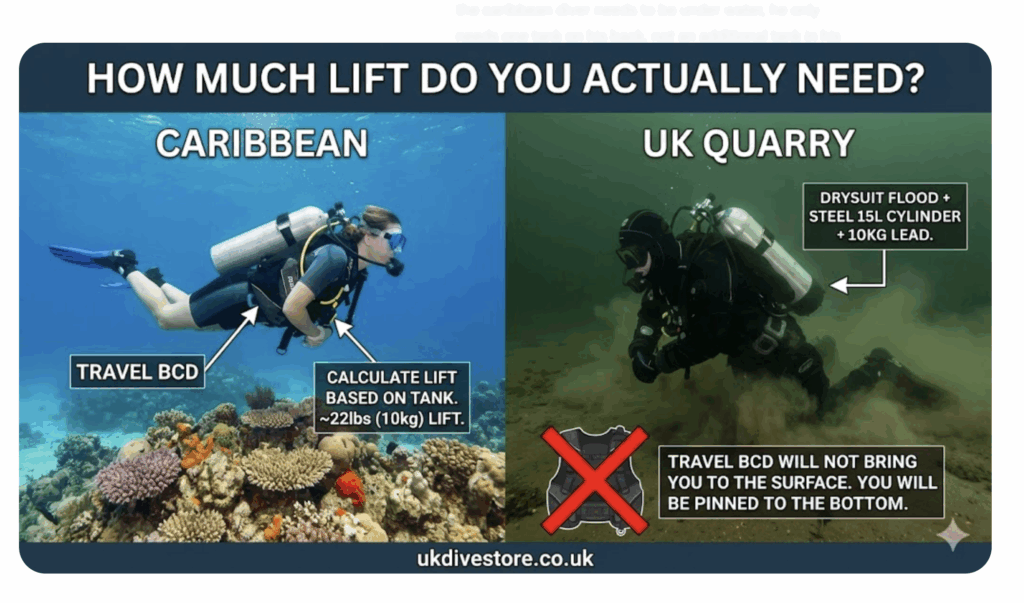
The “Flooded Suit” Formula
You wear lead primarily to sink the air in your drysuit and undersuit. If your drysuit floods (zipper failure or seal rip), that air is replaced by water.
- The Consequence: You instantly lose the positive buoyancy of the suit, but you are still wearing the heavy lead required to sink it.
- The Calculation: Your BCD must be able to lift:[Your Lead Weight] + [Weight of Gas in Tank] + [Negative Buoyancy of Steel Tank]
The Real-World Numbers (Single Tank Example)
- Lead: Average UK drysuit diver wears 10kg – 12kg of lead (V-weight + Belt).
- Gas Weight: Air in a full 12L cylinder weighs approx 3kg.
- Steel Tank: A 12L Faber steel tank is approx 2kg negative in water.
- Total Lift Required: 12kg (Lead) + 3kg (Gas) + 2kg (Tank) = 17kg (37 lbs).
The Verdict: A 30lb (13kg) travel wing is mathematically incapable of lifting a flooded UK diver at the start of a dive.
Recommendation: For single cylinder UK diving, 30lbs is the absolute minimum. 40lbs is the comfortable standard (especially if you dive a 15L tank or heavy undersuits).
Bestsellers
Products by Category
-
Apeks EVX200 Stage 3 Regulator System + Miflex Pressure Gauge & BCD Hose Bundle
Original price was: £1,109.98.£998.98Current price is: £998.98. -
Apeks Ultimate EVX200 Regulator, Exotec BCD, Gauge & Hose Dive Package
Original price was: £1,945.08.£1,750.57Current price is: £1,750.57. -
Aqualung Pro HD and Apeks XTX50 DST Diving Package
Original price was: £1,336.49.£1,202.84Current price is: £1,202.84. -
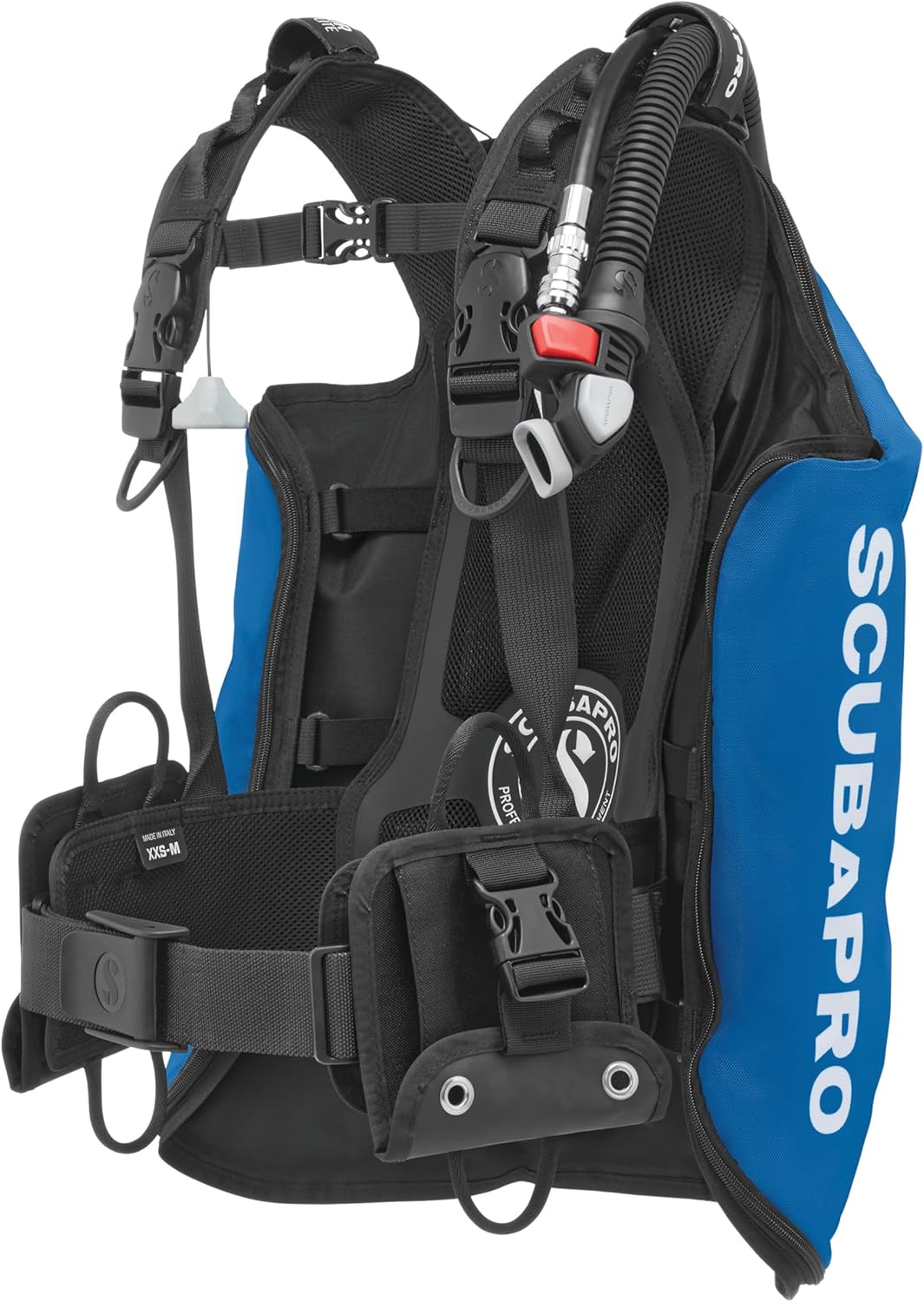
SCUBAPRO NAVIGATOR LITE XXS-M BLU W/BPI
£683.63 -

Scubapro S-Tek Pro Harness, with Back Plate
£492.04 -
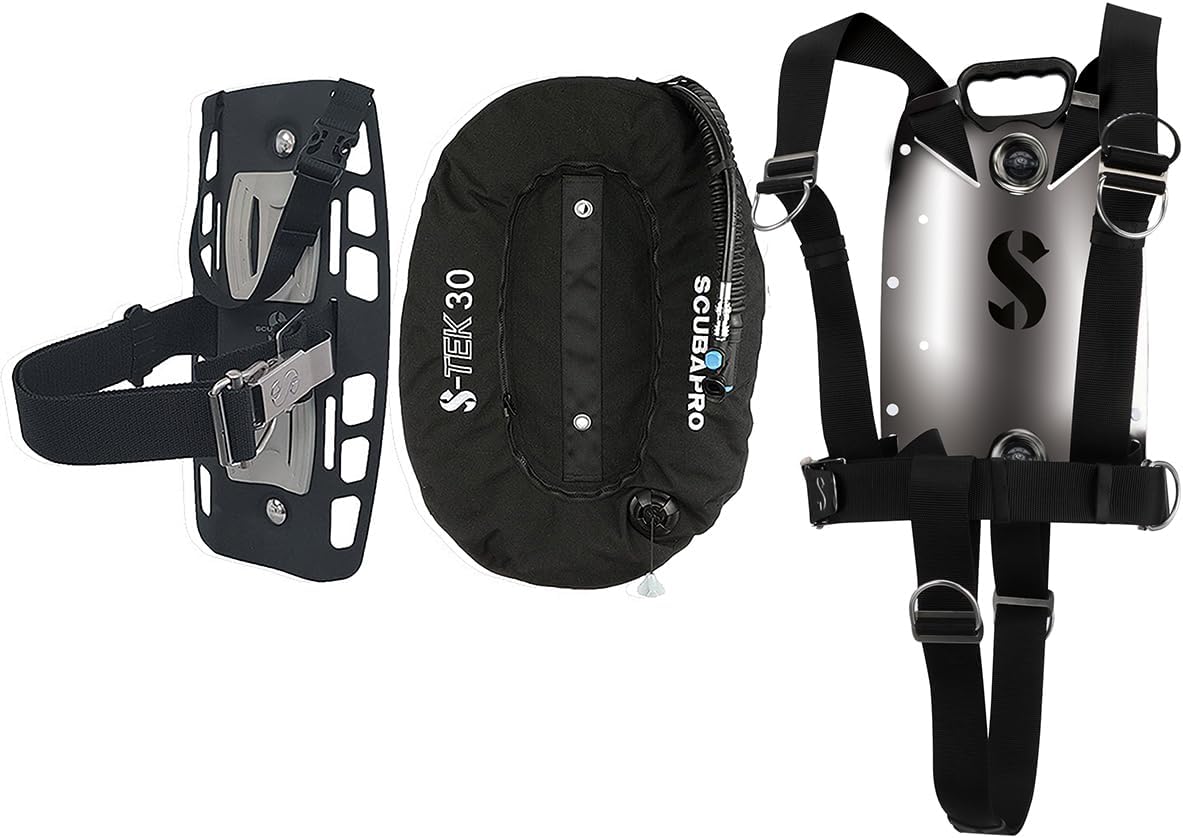
Scubapro S-TEK PURE TEK 30 SET
£993.27 -

xDeep NX Zen Deluxe Scuba Diving BCD for Single Tank (Large Backplate, Stainless – No Weight Pockets)
£880.98 -

Xdeep Weight Pockets 2 Units XL
£86.87
Essential BCD Selection Criteria
Discover key factors for UK cold-water diving safety.
Lift Capacity
Choose BCDs providing sufficient lift for heavy gear.
Durability and Materials
Opt for robust fabrics built for harsh underwater conditions.
Stability and Fit
Ensure a secure fit for balanced buoyancy control.
Adjustability
Select BCDs with versatile adjustments for comfort.
Safety Features
Look for reliable inflators and dump valves for control.
Durability: The “Grit Factor”
UK quarries like Chepstow are lined with slate, grit, and rusting metal platforms. Wrecks are covered in sharp barnacles.
- The Material Metric: You must look at the Denier (D) rating of the outer shell.
- Travel BCDs: Usually 420D Nylon. This saves weight but shreds when dragged against a slate wall or wreck plating.
- UK “Tech” BCDs: Look for 1000D Cordura or 1680D Ballistic Nylon.
- The Inner Bladder: Ensure the wing has a separate inner bladder (often 400D). If the outer shell is punctured by a wreck, the inner bladder remains intact. Single-layer “travel wings” puncture instantly.
Stability: The “Taco” Effect
Cheap wings or oversized BCDs allow air to migrate to the edges, wrapping around the tank like a taco.
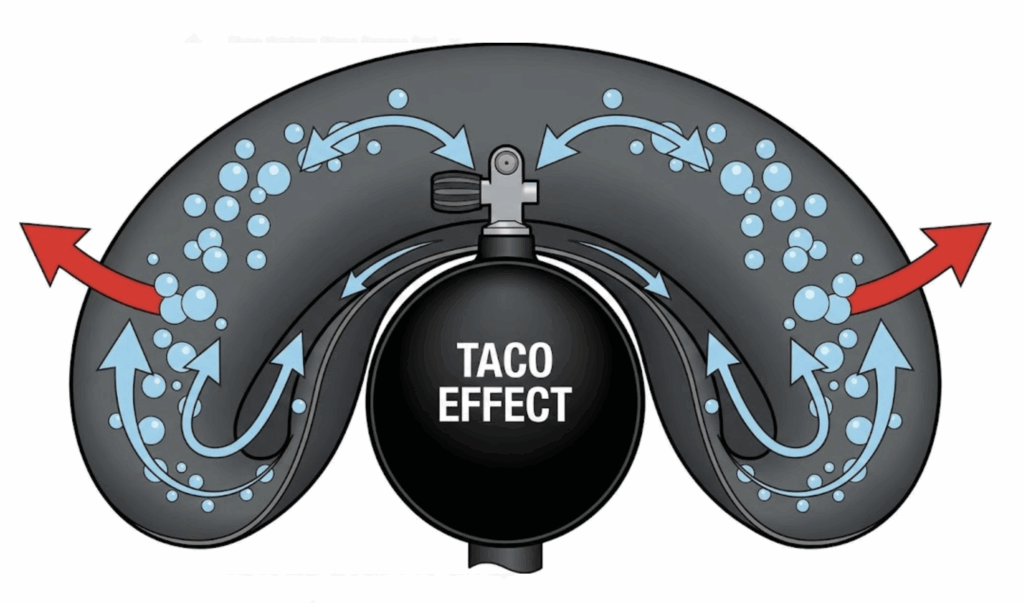
- The Problem: In choppy UK surface conditions, this makes you roll face-forward.
- The Solution: Look for a Donut Wing (continuous loop) rather than a Horseshoe wing.
- Why? Air can circulate 360 degrees. If you roll left, the air moves right to correct you. It provides a stable platform in rough seas compared to air getting trapped in one side of a horseshoe.
Buoyancy Control Systems
Premium Jacket, Wing, and Hybrid BCDs for recreational and technical diving.


Mastering Buoyancy Control for Safe UK Diving
Explore key factors like lift capacity, durability, and stability to choose the perfect BCD for cold-water conditions.
Optimized Lift Capacity
Ensure your BCD provides ample lift to maintain neutral buoyancy, enhancing safety in the UK’s chilly waters.
Durable Build Quality
Select BCDs crafted from robust materials designed to withstand the rigours of frequent cold-water dives.
Enhanced Stability and Comfort
Find BCDs that offer excellent stability and ergonomic fit, ensuring comfort and control underwater.
When buying a BCD for home waters, ignore the “Travel weight” column and look for these three numbers:
| Feature | The UK Spec | Why? |
| Lift Capacity | 30lbs – 40lbs | Lifts a flooded drysuit + 12kg lead. |
| Outer Shell | 1000D+ Cordura | Resists slate, barnacles, and rust. |
| Backplate | Stainless Steel (3mm) | Adds 2.5kg of trim weight (removing it from your waist). |
| Shape | Donut (Continuous) | Prevents surface rolling in waves. |