Master Cold Water Diving with Confidence and Safety
Discover essential insights into cold water diving, focusing on safety, thermal protection, and physiological effects to enhance your underwater experience.

Comprehensive Thermal Protection Guidance
Learn how to select and use the right thermal gear to maintain body heat, ensuring comfort and preventing hypothermia during cold dives.

Understanding Cold Water Physiology
Explore how cold temperatures affect the human body and decompression safety, enabling safer dive planning and execution.

Expert Advice from UK Dive Store’s Technical Team
Benefit from professional tips and strategies to manage cold water challenges, improving safety and enjoyment underwater.
Conquering the Challenges of Cold Water Diving
Explore the physiological effects of cold water and learn how proper thermal protection ensures safe, comfortable dives in UK waters.
Understanding Cold Water’s Impact on the Body
Discover how cold temperatures affect circulation and nerve function, and why choosing the right gear is vital to prevent hypothermia.
Thermal Protection Gear Selection
Find expert advice on wetsuits, drysuits, and layering techniques that maintain warmth and flexibility during cold dives.
Safety Considerations and Decompression
Learn how cold water influences decompression safety and how divers can adapt their protocols to stay protected underwater.

Why You Get Cold: The Physiology of UK Diving
It’s Not Just About Comfort; It’s About Decompression.
By the UK Dive Store Technical Team
If you have ever stood on the quayside at Scapa Flow in November, watching the grey swell roll in, or broken the ice on a puddle in the car park at Stoney Cove, you know the fundamental truth of British diving: It is cold.
For many, the cold is seen as a rite of passage—a test of grit that separates the “holiday divers” from the hardened UK enthusiast. We joke about it. We shiver through surface intervals with a cup of lukewarm tea, wearing our discomfort like a badge of honour.
But there is a dangerous misconception in our community. We tend to view being cold as a mere annoyance, a comfort issue that we simply have to “tough out.”
This attitude is wrong. In the hostile environment of underwater exploration, cold is a physiological hazard. It is a thief that steals your dexterity, clouds your judgement, and, most critically, fundamentally alters the way your body eliminates nitrogen.
To dive safely in the UK, you don’t just need to buy a drysuit; you need to understand the biology behind the shiver. You need to understand the physics of heat loss and the physiological mechanism of vasoconstriction.
This guide explores why we get cold, how that cold impacts our decompression safety, and the science of staying warm.
Part 1: The Physics of the Freeze
Why Water always Wins
To understand why you get cold, we must first look at the physics of heat transfer. The human body acts as a furnace, maintaining a core temperature of approximately 37°C. The North Sea, by contrast, varies between 6°C in winter and perhaps 15°C in late summer.
Thermodynamics dictates that heat will always move from a hotter object to a colder object until equilibrium is reached. The ocean is effectively an infinite heat sink. You cannot warm the ocean; it will only cool you.
There are four mechanisms of heat loss, but for the diver, one reigns supreme.
1. Conduction (The Primary Enemy)
Conduction is the transfer of heat through direct contact between materials. Air is a fantastic insulator because its molecules are spread far apart, making it difficult for heat energy to jump from one to the next. Water, however, is dense. Its molecules are packed tightly together.
Because of this density, water conducts heat away from the body roughly 20 to 25 times faster than air.
This is why 10°C air feels crisp and refreshing, but 10°C water feels dangerously cold within minutes. If you are diving in a wetsuit, or if your drysuit floods, water comes into direct contact with your skin, and the heat is stripped from your body at a terrifying rate. Even in a drysuit, if your undersuit is compressed or damp, you lose the protective air gap, and conduction bridges the gap between your skin and the freezing water outside.
2. Convection
Convection occurs when a fluid (water or air) moves across the skin, carrying heat away. If you are diving in a drysuit, the air inside the suit warms up. If you move around, or if you flush fresh gas into the suit, that warm air is displaced and replaced by cooler air (or gas from your cylinder).
3. Radiation
Your head is a radiator. Because the head has a high blood supply and relatively thin skin, you radiate a massive amount of infrared heat energy into the surrounding water. This is why a high-quality hood is non-negotiable.
4. Evaporation
This is primarily a surface interval issue. When you exit the water, the wind evaporates the moisture on your wet equipment (or your skin), extracting latent heat in the process. This leads to the rapid cooling often felt immediately post-dive.
Part 2: The Physiological Response
Homeostasis and the Core
Your body’s primary directive is homeostasis—keeping the machine running. Your vital organs (heart, lungs, brain) operate within a very narrow temperature window. If the core temperature drops below 35°C, you enter mild hypothermia. Below 32°C, the electrical impulses of the heart are disrupted, leading to arrhythmias and potential death.
To prevent this, the body has a ruthless defence mechanism. It prioritises the Core at the expense of the Shell (limbs and skin).
The Mechanism: Vasoconstriction
When the brain detects a drop in blood temperature, the hypothalamus triggers the autonomic nervous system to initiate peripheral vasoconstriction.
The blood vessels in your extremities (hands, feet, arms, legs) have muscular walls. Upon command, these muscles contract, narrowing the diameter of the vessels. This restricts blood flow to the skin and limbs, effectively shunting the warm blood volume into the deep core.
Think of it as closing the radiators in the spare rooms of a house to keep the boiler working efficiently for the main living room.
The Immediate Impact:
- Numbness: With reduced blood flow, your nerves receive less oxygen and warmth. Your fingers become stiff and clumsy. In a diving scenario, this loss of dexterity is dangerous. Can you manipulate a bolt snap, deploy a DSMB, or trigger your inflator with frozen hands?
- Increased Urination (Immersion Diuresis): As blood is squeezed out of the limbs and into the core, the blood pressure in the torso rises. The body misinterprets this as an overload of fluid. The kidneys respond by filtering out water to lower the pressure, resulting in the “need to pee.” This leads to dehydration, which further thickens the blood—a critical factor in decompression sickness risk.
Part 3: The Silent Killer – Cold and Decompression
The Perfusion Trap
This is the most critical section of this guide. Many divers believe that being cold is just uncomfortable. However, for the UK diver, cold is a significant risk factor for Decompression Sickness (DCS).
We dive using decompression models (like Bühlmann ZHL-16C) that track the uptake (on-gassing) and elimination (off-gassing) of inert gases like Nitrogen or Helium. These models rely on the concept of perfusion—the flow of blood through tissues.
The algorithm assumes your blood is flowing at a relatively constant rate. It assumes that if you on-gas X amount of nitrogen at depth, you will be able to off-gas Y amount during your ascent and stops.
Cold destroys this assumption.
The “Hot On, Cold Off” Scenario
Consider a typical UK wreck dive.
The Descent and Bottom Phase (Hot On): You jump in. You are full of energy. You kick against the current to get down the shotline. You are working hard swimming around the wreck.
- Physiology: Your metabolic rate is high. Your heart is pumping. Your blood vessels are dilated to supply oxygen to your working muscles.
- Result: You are On-Gassing nitrogen rapidly. Your tissues are soaking up inert gas efficiently because perfusion is high.
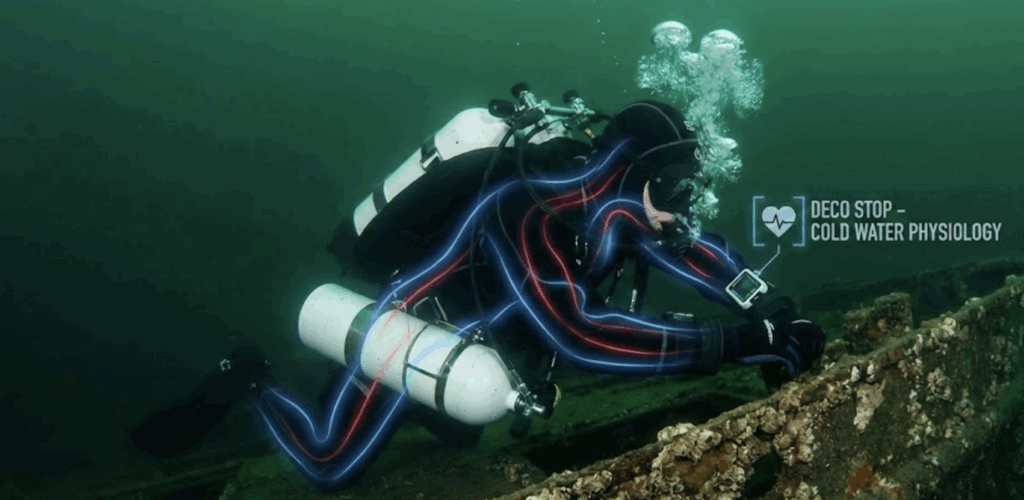
The Ascent and Deco Stop (Cold Off): The dive ends. You drift up to your decompression stop. You are now stationary, hanging on a line or a DSMB. You are no longer working. The water has chilled you for 45 minutes.
- Physiology: You get cold. Vasoconstriction kicks in with a vengeance. The body shuts down blood flow to the extremities and muscle tissues to protect the core.
- Result: You are trying to Off-Gas, but the doors have been slammed shut. The blood flow required to transport nitrogen from your tissues back to your lungs for elimination has been restricted.
The Danger: Your dive computer doesn’t know you are cold. It counts down the minutes based on a theoretical model of normal perfusion. It tells you that you are “clean” to surface. However, because of vasoconstriction, your tissues still hold a dangerous load of nitrogen that hasn’t been washed out. You surface, the pressure drops, and that trapped nitrogen expands into bubbles. You take a hit.
This is why staying warm during the decompression phase is not a luxury; it is a safety requirement.
Part 4: The Mental Toll
The Distraction Factor
Beyond the bends, cold affects the mind. Hypothermia is insidious. It starts with shivering—the body’s attempt to generate heat through muscle friction. Shivering increases your oxygen consumption significantly, which depletes your gas supply faster (increasing your SAC rate).
As the cold deepens, you experience the “umbles”:
- Stumbles: Loss of motor control.
- Mumbles: Difficulty speaking or communicating.
- Fumbles: Inability to operate equipment.
- Grumbles: Irritability and a “get me out of here” attitude.
A cold diver is a distracted diver. Instead of monitoring your PO2, your depth, or your buddy, you are fixated on your own misery. You are more likely to rush safety stops, skip protocols, or make poor decisions just to end the exposure. In a technical diving environment, this mental degradation can be fatal.
Part 5: The Physics of Insulation
It’s All About the Air
So, how do we defeat the cold? We fight physics with physics.
It is important to realise that your drysuit does not keep you warm. A shell drysuit (trilaminate/membrane) is simply a waterproof bag. It has almost zero thermal insulation properties. Its job is solely to keep the water away from your insulation.
You keep you warm. Your body generates the heat. The job of your thermal protection system is to trap that heat and prevent it from escaping via conduction.
To do this, we need Air. As we established, air is a poor conductor of heat (a good insulator). The goal of any undersuit is to trap a layer of air against the skin and hold it there.
The Challenge of Depth (Boyle’s Law)
This is where diving differs from mountaineering. A climber can wear a down jacket. If a diver wears a down jacket, as they descend, the water pressure increases. By 30 metres (4 atmospheres of pressure), the air bubbles in the down jacket are crushed flat. The air gap disappears. The insulation value vanishes.
Diving undersuits must be Compression Resistant. We use materials like high-density Thinsulate or Halo 3D fleece which have a structure designed to resist crushing. They maintain their “loft” (thickness) even under the crushing weight of the water, preserving that vital air gap.
Part 6: The Art of Layering
The UK Diver’s System
To survive UK waters, you cannot rely on a single garment. You need a modular system.
Layer 1: The Base Layer (Moisture Management)
This is the most overlooked layer. Cotton is the enemy. Cotton is hydrophilic; it loves water. If you sweat in a cotton T-shirt inside a drysuit, the fabric absorbs the moisture and holds it against your skin. Water conducts heat 25 times faster than air. You have effectively wrapped yourself in a cold compress.
You need a hydrophobic base layer. Materials like Merino Wool or advanced synthetics (Polyester/Polypropylene) do not absorb water. Instead, they wick it. They pull the sweat away from the skin and push it out to the next layer. This keeps your skin dry, which is the first step to staying warm.
Layer 2: The Mid Layer (The Loft)
This is your primary insulation (the “woolly bear”). The thickness of this layer depends on the season.
- Summer: A 100g or 200g Thinsulate suit.
- Winter: A 400g or 450g heavy-duty suit. This layer provides the bulk that traps the air. It must be breathable to allow the moisture from the base layer to pass through it to the inside of the drysuit shell, preventing clamminess.
Layer 3: The Shell (The Drysuit)
The drysuit protects the air gap.
- Fit is critical. If a suit is too tight, it compresses the undersuit, destroying the loft. If it is too loose, large pockets of air move around (convection), cooling you down and making buoyancy control difficult.
- The Argon debate: Some technical divers use Argon gas to inflate their drysuits instead of Air/Nitrox. Argon is a denser gas and offers slightly better thermal insulation properties (approx. 20% better). While effective, for most divers, a better undersuit offers a higher return on investment than an Argon system.
Layer 4: The Extremities
- The Head: As noted, the head is a major heat loss zone. A 3mm hood is insufficient for the UK. You need 5mm minimum, preferably 7mm-10mm.
- The Hands: Wet gloves work by trapping a layer of water which your body heats. In 6°C water, this is often not enough for long dives. Dry Gloves are the ultimate solution. They allow you to wear a fleece liner, keeping your hands surrounded by air, not water. This preserves dexterity and tactile feedback.
Part 7: Active Heating
The Modern Era of Warmth
In recent years, battery technology has revolutionised thermal protection. Heated Vests and Heated Undersuits are now common in the UK technical scene.
These systems use heating elements (usually carbon fibre) powered by an external battery pack (routed through the drysuit valve) or an internal battery.
The Benefits: Active heating actively pumps energy into the system, combating the heat loss. This is particularly useful during the static decompression phase (the “Cold Off”). By switching on a heated vest at the start of your ascent, you can encourage blood flow, keeping the capillaries open and assisting with off-gassing.
The Risks:
- The Failure Point: If you rely on a heater to survive a 90-minute dive, and the battery fails at minute 20, you are in trouble. You must carry enough passive insulation (undersuits) to survive the dive without the heater. The heater is a bonus, not a crutch.
- The Burn: Poorly made systems can cause contact burns. Always wear a base layer between the heater and your skin.
- Isobaric Counter-Diffusion (Advanced): There is a theoretical risk regarding switching gases and temperature gradients, but for most, the primary risk is simply reliance on technology that can fail.
Guidance: Use active heating to stay safer (better deco), not just to extend your dive time beyond your thermal limits.
Part 8: Pre and Post Dive Logistics
The Battle is Won on the Surface
Staying warm isn’t just about what you wear underwater; it’s about how you manage your body on the surface.
1. Hydration Dehydration thickens the blood (increases viscosity). Thick blood circulates poorly, exacerbating cooling and DCS risk. Drink water before the dive (despite the inconvenience of needing to pee).
2. Fuelling the Furnace Shivering and generating heat burns calories. Eat a slow-release carbohydrate meal (porridge, pasta) before diving to ensure your metabolic furnace has fuel.
3. The Surface Interval Don’t stand in the wind in your wet undersuit. If you are doing two dives, get out of the wind immediately. Wear a windproof changing robe. Put a beanie hat on the second your hood comes off. If your undersuit is damp from sweat, change it. A dry diver is a warm diver.
4. The After Drop When you finish a dive and start to warm up (perhaps in a hot shower or a warm car), the blood vessels in your limbs dilate (vasodilation). The cold, stagnant blood that was trapped in your arms and legs rushes back to the core. This mixes with the warm core blood, causing the core temperature to drop further—even though you are in a warm environment. This is the After Drop.
- Prevention: Warm up slowly. Keep your drysuit on (half-mast) or wear warm clothes. Don’t jump straight into a boiling hot shower, as this can cause fainting due to rapid blood pressure changes. Drink warm, non-alcoholic fluids.
Conclusion: Warmth is Discipline
Diving in the UK is a world-class experience. The wrecks of the south coast, the seals of the Farnes, and the dramatic geology of our inland sites offer adventures that rival anywhere on the planet.
But the North Atlantic does not care if you are having fun. It operates on cold, hard physics.
Ignoring the cold is not tough; it is negligent. By understanding the physiology of heat loss and investing in a proper thermal protection system, you are not just buying comfort. You are buying safety. You are buying the ability to think clearly at 40 metres. You are buying efficient off-gassing and a lower risk of the bends.
Treat your thermal protection with the same respect you treat your regulator.
- Layer correctly.
- Prioritise compression-resistant materials.
- Protect your extremities.
- Keep your decompression phase warm.
Stay warm. Stay safe. And enjoy the dive.
This guide is provided for educational purposes by UK Dive Store. Always seek professional training for drysuit and cold-water diving.
Dive Into Our Cold Water Diving Insights
An expert guide by UK Dive Store’s Technical Team on managing the challenges and safety essentials of diving in cold UK waters.

Understanding Cold Water Effects
Explore how cold water impacts the human body and why thermal protection is vital.
Thermal Protection Strategies
Learn about selecting and using the right suits and gear to maintain warmth and safety underwater.
Cold Water Decompression Safety
Understand how cold affects decompression and what precautions to take for safe ascents.
Practical Tips for UK Cold Water Diving
Get expert advice on preparation, equipment maintenance, and diving practices tailored for cold UK waters.
Dive Confidently into Cold Waters
This section describes the key features briefly.

Understanding Cold Water Physiology
Learn how cold affects your body and diving safety.
Choosing the Right Thermal Protection
Discover essential gear to stay warm and safe underwater.
Safety Strategies for Cold Water Diving
Expert tips to maintain comfort and prevent hypothermia.
Impact of Cold on Decompression
Explore how temperature influences decompression risks.
Dive Deeper Into Cold Water Safety
Discover vital insights to enhance your cold water diving experience and stay protected beneath the surface.